Finding a reliable China Top Clay Tiki Head Manufacturer and Supplier requires more than comparing prices. A strong supplier should understand ceramic materials, cultural design details, and consistent production control. The right partner can turn a rough sketch into a durable Clay Tiki Head with balanced proportions, clear facial features, and a stable base.
Experienced manufacturers usually explain their clay body, firing temperature, glaze options, and inspection process. These details matter. A poorly fired piece may develop hairline cracks after shipping. Uneven glaze can also change the intended expression. Factory visits, sample reviews, and production photos provide useful evidence of practical experience. However, photos alone are not enough. A sample should be handled, measured, and checked under natural light.
Customization is often a major advantage when working with Chinese ceramic suppliers. Buyers may request private molds, specific colors, embossed logos, gift packaging, or different sizes. Reliable teams confirm these details before mass production begins. They also discuss lead times, carton protection, and replacement policies clearly. Small gaps can still appear. Hand finishing is rarely perfectly identical, and that difference may be part of the product’s character.
This guide explores how to evaluate a China Top Clay Tiki Head Manufacturer and Supplier with careful judgment. It considers craftsmanship, communication, quality assurance, and long-term cooperation. The best supplier is not always the cheapest. It is the one that delivers consistent results, answers difficult questions, and improves when a design needs refinement.
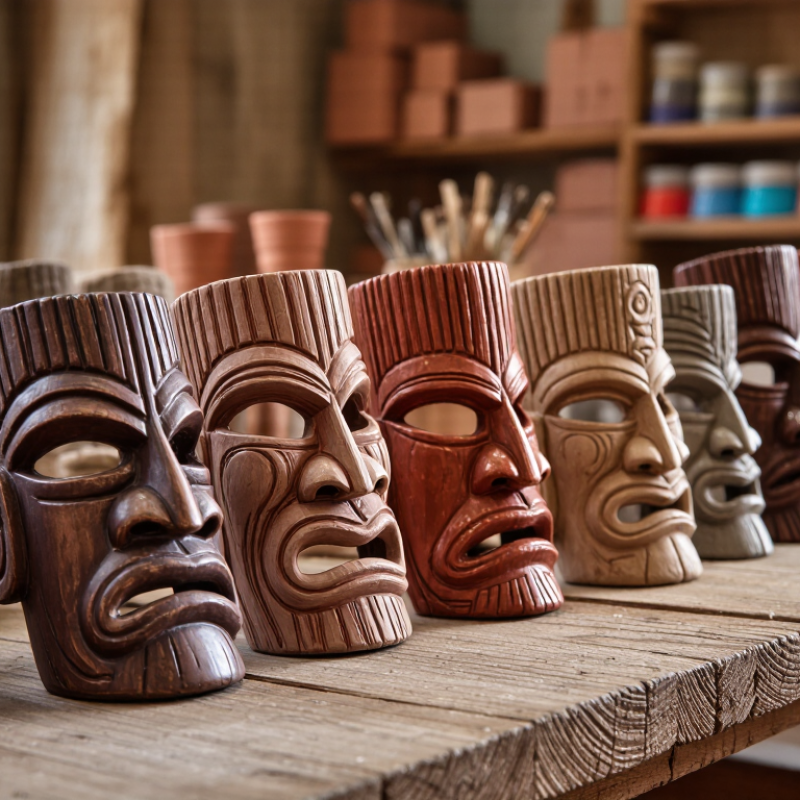
A clay tiki head is a hand-shaped ceramic decoration inspired by stylized island carvings. It usually shows bold eyes, a wide mouth, and carved facial lines. Unlike a solid stone figure, a clay version may be hollow, lighter, and easier to place. After shaping, the piece is dried, fired, glazed, and fired again when a stronger finish is needed. Its surface may feel slightly uneven. That is often part of its character.
Many people use a clay tiki head as a planter for small succulents or trailing plants. The open mouth can create a playful display, while drainage holes help protect the roots. It can also serve as a shelf ornament, garden accent, or themed hospitality decoration. Keep unglazed pieces under cover in freezing weather. Moisture can enter tiny pores and cause cracking.
Reliable manufacturers and suppliers should explain the clay body, firing temperature, dimensions, packaging, and care instructions. They should also provide clear photos of the actual finish, not only polished samples. From practical inspection, the rim, base, and facial projections need extra attention because they are vulnerable during shipping. I would not call every handmade piece flawless. Small glaze variations happen. However, serious suppliers inspect each unit, use protective inserts, and discuss customization honestly before production. Proper testing still matters.
Clay tiki heads begin with a practical design brief. Designers study facial proportions, wall thickness, and hanging balance before shaping the first model. Hand sketches often show wide eyes, carved brows, and a strong mouth line. These details must remain clear after firing. A clay head is expressive, but it is also a fragile ceramic object.
Craft workers usually build the form with stoneware or earthenware clay. They remove air pockets, shape the surface, and let the piece dry slowly. Rushed drying can create cracks around the nose or forehead. After bisque firing, artisans inspect every face under bright light. Glaze is then brushed or sprayed in controlled layers. Color may soften during firing, so test tiles are essential. Not every first sample is right. That is normal, and careful suppliers record each adjustment.
Tips: Ask for a material sample, firing temperature, size drawing, and packaging test. Check drainage, wall thickness, and color consistency before placing a larger order. A useful supplier should explain production limits clearly, not promise perfect uniformity. Small variations may show authentic handcraft, but sharp edges and structural cracks require rejection. Reliable quality control includes moisture checks, kiln records, visual inspection, and drop testing for export packaging. Even experienced teams can miss a tiny glaze pinhole. A second inspection helps.
This chart presents typical working and processing times for a ceramic clay tiki head, including design, sculpting, drying, firing, glazing, and final inspection. Drying and kiln firing require the most time because moisture must be removed gradually and the ceramic body must mature under controlled heat. Actual production times vary according to the clay body, head size, wall thickness, glaze system, and kiln capacity.
Choosing a top clay tiki head manufacturer and supplier requires more than attractive photos. The material recipe determines strength, texture, and firing stability. A dependable workshop often combines stoneware clay, fine kaolin, and controlled grog. Grog helps reduce shrinkage and improves resistance to cracking. Too much grog, however, can make facial details appear rough.
Experienced production teams inspect the clay before molding. They check moisture, plasticity, and particle consistency. After forming, each tiki head should dry slowly in a controlled room. Sudden temperature changes may create hidden stress. The first firing usually confirms the body’s strength and dimensional stability. Glazes should bond evenly without pinholes, crawling, or sharp edges. Keep testing.
Quality standards should include measured dimensions, weight tolerance, color consistency, and surface inspection. For decorative or food-contact applications, buyers should request suitable safety documentation for glaze composition. Testing for restricted substances may also be necessary in the destination market. Batch records, firing temperatures, and inspection photos make supplier communication more reliable.
Handmade clay tiki heads will not always look perfectly identical. Small texture variations can show genuine craftsmanship. Yet cracks, unstable bases, exposed sharp edges, and glaze contamination should not be accepted as character. A careful supplier samples every batch and records defects honestly. That discipline matters when custom molds, repeated orders, or large shipments are involved. There is room to improve. Suppliers should review failed pieces, adjust firing curves, and refine packing methods instead of hiding weaknesses.
Choosing a reliable clay tiki head supplier begins with the material, not the catalog photo. Ask for the clay type, firing temperature, and surface treatment. A professional supplier should explain how these choices affect strength, weight, and color stability. Request a physical sample before placing a large order. Photos hide small cracks.
Inspect the sample under bright light. Check the facial details, wall thickness, glaze coverage, and hanging hardware. The piece should feel balanced, without sharp edges or loose particles. Ask whether each head is hand-finished or produced with molds. Both methods can work, but they create different textures and price levels. In my experience, clear production records reveal more than attractive promises. A supplier should provide dimensions, packing details, lead times, and realistic tolerances. Vague answers deserve caution.
Communication also matters. Send a simple drawing with measurements and confirm every change in writing. Reliable suppliers usually offer a pre-production sample and photographs during packing. Ask how they handle breakage, color variation, and delayed shipments. A replacement policy should be specific, not merely polite. I once focused too heavily on a low unit price and overlooked weak packaging. Several pieces arrived with chipped corners. That mistake changed my inspection process. Still, no checklist is perfect. Review recent customer feedback, verify export experience, and compare at least three quotations. A dependable clay tiki head supplier should make quality easier to verify, not harder.
Choosing a clay tiki head manufacturer in China requires more than a catalog photo. An experienced supplier should discuss clay body, mold details, glaze behavior, and firing temperature before accepting a custom order. We review drawings, dimensions, wall thickness, colors, and mounting needs with each buyer. A small prototype helps reveal shrinkage or uneven facial details. It costs extra time. That step prevents expensive surprises later.
Pricing depends on size, clay weight, mold complexity, finishing, order quantity, and packing method. Custom tooling is usually quoted separately, while sample fees may be credited to a larger production run. A dependable quotation should list unit price, sampling, inspection, cartons, and shipping terms. We also confirm production lead time in writing. Estimates can change when glaze tests fail. That part is easy to underestimate.
For packaging, each head needs a fitted inner layer, moisture-resistant protection, and a strong export carton. Fragile protruding features require extra space, not just thicker tape. Before dispatch, we check dimensions, color consistency, surface cracks, and carton marks. Global shipping can be arranged by sea, air, or rail, depending on urgency and budget. Export documents, product descriptions, and destination requirements should be confirmed early. Import duties and local handling charges remain the buyer’s responsibility. Some plans need revision.
| Category | Typical Specification | Common Commercial Range | Custom-Order Notes | Quality and Shipping Considerations |
|---|---|---|---|---|
| Material | Fired ceramic clay, stoneware clay, or terracotta clay | Approx. 1,000–1,250°C firing temperature for ceramic bodies | Material selection depends on color, strength, porosity, and intended indoor or outdoor use | Outdoor products should use an appropriate glaze and be tested for water absorption and freeze-thaw conditions |
| Standard Size | Approximately 15–30 cm high; 12–25 cm wide | Small decorative pieces are generally lower-cost and easier to ship | Custom dimensions can be developed from drawings, reference images, or a physical sample | Larger dimensions increase mold, packing-material, pallet, and freight costs |
| Surface Finish | Glazed, matte, unglazed, speckled, antiqued, or hand-painted | Simple single-color finishes usually have the shortest production cycle | Color references may be matched using physical samples or recognized color systems | Hand-painted details may require an approved color sample and a defined tolerance for variation |
| Approximate Unit Pricing | Indicative export pricing for unbranded ceramic decorative items | About US$8–25 per piece for basic designs; US$25–80+ for larger or highly detailed designs | Final pricing depends on size, clay body, mold cost, decoration, quantity, packaging, and trade terms | Prices are indicative market ranges and should be confirmed by a written quotation and approved sample |
| Minimum Order Quantity | Common production MOQ: approximately 50–300 pieces per design | Sample orders are normally priced higher per piece than bulk orders | MOQ may change according to mold investment, glaze complexity, and packaging requirements | Confirm whether mixed colors or mixed designs count toward the same MOQ |
| Prototype and Sample | 3D model, master prototype, mold trial, and pre-production sample | Typical sample development: 7–30 days, excluding complex sculpture revisions | A sample approval should cover dimensions, weight, facial details, glaze, color, and surface defects | A signed or documented sample standard helps reduce disputes during mass production |
| Production Lead Time | About 25–45 days after sample approval and deposit | Complex shapes, multiple colors, or peak-season orders may require 45–60 days | Lead time should include molding, drying, bisque firing, glazing, final firing, inspection, and packing | Air-drying and kiln capacity can affect schedules, especially for thick or large ceramic forms |
| Packaging | Individual protective wrapping, molded foam or pulp inserts, inner carton, and export carton | Packaging cost commonly increases with fragile protrusions and irregular shapes | Options may include custom carton printing, barcode labels, color boxes, and drop-test packaging | Use strong five-ply export cartons, internal separation, moisture protection, and “Fragile” handling marks where appropriate |
| Inspection Points | Dimensions, weight, cracks, chips, pinholes, glaze coverage, color consistency, and packing condition | AQL-based inspection can be arranged for larger purchase orders | Define acceptable limits for minor glaze variation, handcrafted marks, and color differences before production | Photographs, carton counts, and inspection reports should be retained before shipment |
| Shipping Methods | Courier, air freight, rail, or ocean freight from China | Ocean freight is generally more economical for bulky or palletized orders | Select EXW, FOB, CIF, DAP, or another agreed Incoterm according to the buyer’s logistics capability | Freight quotations require destination, carton dimensions, gross weight, volume, and shipping terms |
| Typical Transit Time | Courier: 3–10 days; air freight: 5–15 days; ocean freight: approximately 20–45 days | Transit time varies by destination port, carrier schedule, customs, and seasonal congestion | Allow additional time for export clearance, import customs, local delivery, and possible inspection | Delivery estimates are not guaranteed until the carrier booking and destination details are confirmed |
| Documentation | Commercial invoice, packing list, transport document, and origin information when required | Additional documents depend on destination-country customs and product regulations | Confirm product description, HS classification, declared value, and consignee details before dispatch | The importer is responsible for verifying local duties, taxes, labeling, and entry requirements |
| Best Use | Home décor, hospitality interiors, themed venues, retail displays, gifts, and collectible décor | Suitability depends on glaze safety, structural strength, and whether the item is decorative or functional | Clearly state whether the product is for decorative use only and whether it is suitable for outdoor placement | Avoid describing decorative ceramic items as food-safe or weatherproof unless the relevant tests support those claims |
Note: Pricing, minimum order quantities, lead times, and freight schedules are indicative ranges for unbranded ceramic products made for export. Actual terms must be confirmed through a current quotation, approved sample, packaging specification, and destination-specific shipping calculation.
It is a hand-shaped ceramic decoration with bold eyes, a wide mouth, and carved facial lines. It may be hollow and lightweight. Small uneven areas can show genuine handmade character.
It can hold small succulents or trailing plants. The open mouth creates a playful planter display. It also works as a shelf ornament or garden accent.
Ask about the clay body, firing temperature, dimensions, weight, packaging, and care instructions. Request photos of the actual finish. Polished samples can hide ordinary variations.
Stoneware clay, fine kaolin, and controlled grog can improve stability. Grog may reduce shrinkage and cracking. Too much grog can roughen facial details.
Workers should check moisture, plasticity, and particle consistency before molding. The piece should dry slowly in a controlled room. Sudden temperature changes may create hidden stress.
Serious cracks, unstable bases, sharp edges, and contaminated glaze require rejection. Minor texture differences may be acceptable. Not every handmade piece is flawless.
Size, clay weight, mold complexity, finishing, quantity, and packaging affect pricing. Custom tooling usually costs extra. A prototype can reveal shrinkage before full production.
Each head needs a fitted inner layer, moisture-resistant protection, and a strong carton. Facial projections need empty space around them. More tape alone is not enough.
Keep unglazed pieces covered during freezing weather. Moisture can enter tiny pores and cause cracking. Drainage holes help protect plant roots. Some care plans need revision.
A Clay Tiki Head is a decorative ceramic or terracotta piece commonly used for tropical-themed interiors, gardens, hospitality spaces, cultural displays, and creative landscaping. Its expressive facial features and handcrafted appearance make it suitable as a wall accent, planter, centerpiece, or custom décor element. Designing and manufacturing these pieces involves shaping the form, refining facial details, drying the clay carefully, firing it at controlled temperatures, and applying suitable finishes such as natural textures, colors, or protective coatings.
When choosing a reliable Clay Tiki Head supplier, buyers should evaluate material quality, craftsmanship, production capacity, inspection procedures, and communication. High-quality clay, consistent firing, durable finishes, and secure packaging help reduce damage during transportation. Professional suppliers should also support custom sizes, colors, patterns, logos, and packaging requirements while providing clear quotations based on design complexity, order quantity, and finishing options. For international orders, dependable suppliers should offer organized documentation, export-ready packing, and flexible shipping solutions to ensure products arrive safely and efficiently.