+86 13959259055 [email protected]

10 Pineapple Clay Art Tips for Global Buyers

Time:2026-10-23 Author:Mason
0%

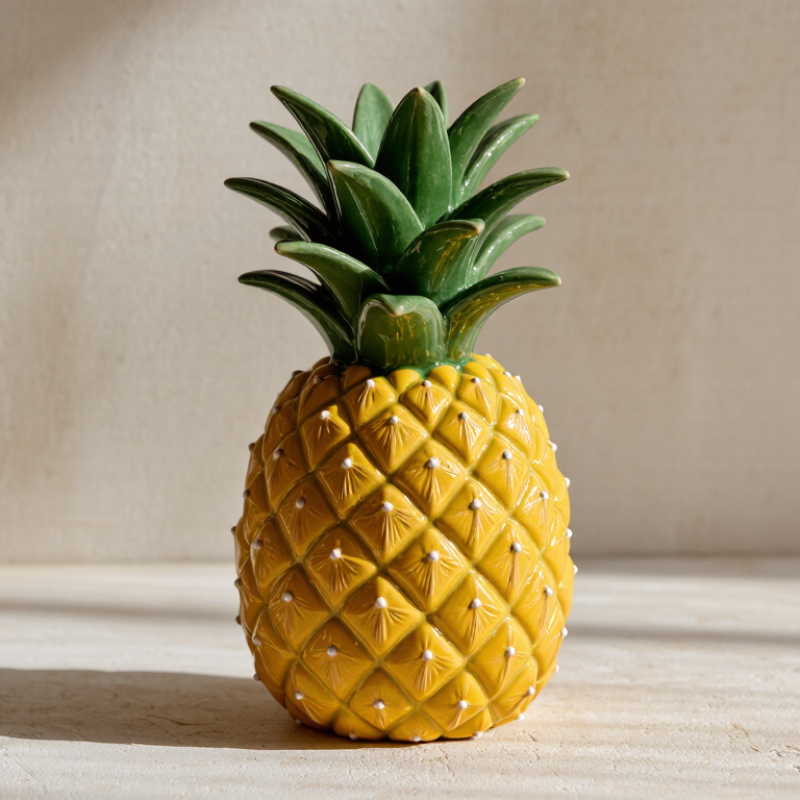
Pineapple Clay Art combines tropical symbolism with the quiet discipline of handmade design. For global buyers, its appeal depends on more than a bright yellow surface. Shape, clay quality, glaze, packaging, and production consistency all influence the final purchase. A pineapple sculpture may look cheerful online, yet a weak base or uneven crown can disappoint when it arrives.

Ceramic product consultant Elena Marquez explains, “A successful clay pineapple must feel tropical, stable, and honestly handmade.” Her observation reflects practical workshop experience. Buyers should inspect the fruit’s scale, the crown’s attachment, and the surface texture. Small details matter. Look for clean leaf edges, balanced proportions, and a finish that suits the intended room. Matte clay can feel warm and natural. Glossy glaze can appear more decorative, but it may reveal fingerprints or uneven firing.

This guide presents ten Pineapple Clay Art tips for international purchasing decisions. It considers sample approval, color accuracy, material descriptions, protective packaging, and communication with suppliers. It also addresses customization, minimum order quantities, and realistic delivery expectations. These points are useful for retailers, interior stylists, and gift buyers. Still, no checklist removes every risk. Handmade pieces vary. Product photos can hide tiny flaws. Even experienced buyers may overlook weight or carton strength. That is why careful sampling remains essential. A better decision often begins with one imperfect sample, examined under natural light and handled before larger orders are confirmed.
10 Pineapple Clay Art Tips for Global Buyers

Understanding Pineapple Clay Art and Its Global Appeal

Pineapple clay art combines a familiar tropical symbol with handmade texture. Its layered leaves suggest welcome, hospitality, and abundance across many cultures. The fruit also photographs well, from a small desk ornament to a large wall piece. Buyers can see the value immediately.

Look for firm clay, clean leaf edges, and a stable base. The surface should feel textured, not chalky or greasy. Ask whether the piece is air-dried, kiln-fired, or sealed with a protective finish. These details affect shipping, moisture resistance, and long-term display. Check the dimensions carefully. A pineapple measuring ten centimeters may appear smaller than expected.

Handmade variation matters. I have seen a slightly uneven leaf make a piece feel warmer and more authentic. However, cracks near the stem deserve attention. Color should remain consistent, unless the design intentionally uses shading. For international orders, request clear photos, packaging details, and care instructions. Foam protection, a rigid box, and moisture-resistant wrapping can reduce transit damage. Avoid placing clay art beside radiators or in direct sunlight. This is easy to forget. Cultural appeal is strongest when the design feels respectful, useful, and honestly handmade. Not every rough detail is a flaw, but not every flaw should be excused.

Choosing Suitable Clay, Tools, Colors, and Pineapple Designs

Choosing the right clay determines whether a pineapple keeps its shape during drying. Air-dry clay suits beginners and international shipping prototypes because it needs no kiln. Polymer clay offers sharper leaves, but it requires controlled oven curing. Ceramic clay creates the strongest results, yet buyers need kiln access and careful moisture control.

USGS Mineral Commodity Summaries 2024 reports about 5.5 million metric tons of kaolin produced in the United States in 2023. Kaolin can improve whiteness and surface smoothness, but it is not automatically ideal for small sculptures. I test a palm-sized sample before producing a collection. My first batches were too smooth; the pineapple looked like polished plastic. That mistake still happens.

Use a metal scraper, needle tool, soft brush, and a simple rolling guide. A blunt tool creates natural skin grooves without cutting deeply. Mix warm yellow with a small amount of ochre for the body. Add muted green, not neon green, to the crown. The 2024 Global Decorative Coatings Market analysis by Grand View Research highlights growing interest in customized visual finishes, which supports using layered color rather than one flat coat. Try a ribbed pineapple, a sliced half, or a miniature fruit bowl. Keep the crown slightly uneven. Perfect symmetry often looks manufactured. Measure thickness carefully, because thin leaves can crack during drying. A test piece is cheaper than a full remake.

10 Pineapple Clay Art Tips for Global Buyers

Choosing suitable clay, tools, colors, and pineapple designs starts with understanding the typical firing requirements of common ceramic clay types.

The values show approximate midpoint firing temperatures commonly used in studio ceramics: earthenware is typically fired at a lower temperature, while stoneware and porcelain require higher temperatures. Always follow the clay manufacturer’s firing instructions.

Shaping Pineapple Forms with Realistic Texture and Detail

10 Pineapple Clay Art Tips for Global Buyers

Shape the pineapple with a tapered oval, not a perfect sphere. Press the clay gently around a small core. Leave slight unevenness for a natural silhouette. A fresh pineapple has shallow curves and irregular shoulders. Add the crown with narrow leaves, using different lengths and angles. Score each leaf base before attaching it. This improves strength during drying. Keep the leaves thin, but not paper-thin. They may warp or crack. I learned this after one crown collapsed overnight.

Build realistic texture with a blunt needle, wooden tool, or stiff brush. Press diagonal lines into the body, creating loose diamond sections. Avoid identical spacing. Real skin looks organized, but never mechanically repeated. Add small raised points at selected intersections. Too many points can make the surface look spiky. Soften some edges with a damp fingertip. Keep the center texture deeper than the shoulder texture. This change helps the form catch light naturally.

For global buyers, confirm clay type, dimensions, weight, and finishing method. Ask whether the piece is air-dried, kiln-fired, or sealed with a protective coating. Request close photos of the crown, base, and surface details. Color can shift between screens and studio lighting. Handmade work may include tiny marks or mild asymmetry. That is not always a defect. Still, major cracks, loose leaves, or unstable bases need careful inspection. My own early pieces were attractive but too fragile for frequent handling. A wider base and slower drying solved much of the problem.

10 Pineapple Clay Art Tips for Global Buyers - Shaping Pineapple Forms with Realistic Texture and Detail

No. Art-Making Dimension Recommended Practice Useful Data or Measurement Buyer-Focused Quality Check
1 Overall Pineapple Silhouette Build a slightly tapered oval body with a wider lower third and a gently narrowed top. Avoid a perfect sphere because a natural pineapple has an uneven, barrel-like profile. A practical proportion is approximately 1.3–1.6:1 for body height to maximum body width, excluding the leafy crown. Check that the piece stands securely and remains visually balanced from the front, side, and three-quarter views.
2 Clay Selection Use polymer clay for durable small decorative pieces, air-dry clay for lightweight craft projects, or ceramic clay for kiln-fired work. Air-dry clay commonly needs about 24–72 hours to dry, depending on thickness, humidity, and ventilation. Polymer clay must follow the curing temperature and time stated on its package. Record clay type, curing or drying requirements, and finished weight so international buyers can plan handling and display.
3 Fruitlet Grid Press shallow diagonal grooves in two directions to form the repeating diamond or hexagonal pattern found on pineapple skin. Keep the grooves shallow, approximately 1–2 mm on a small decorative model, with slight variation in spacing for a handmade appearance. The pattern should follow the body’s curve instead of appearing as a flat crosshatch pasted onto the surface.
4 Raised Skin Texture Add small raised ridges around each fruitlet using a pointed tool, fine clay rope, or controlled stippling. Combine sharp and softened edges to prevent a mechanical look. Use approximately 30–60 visible fruitlet sections on a medium-sized decorative pineapple, depending on scale and design style. Texture should remain visible under normal indoor lighting without creating fragile spikes that can break during handling.
5 Color Layering Blend warm yellow, golden ochre, muted green, and small amounts of brown to create natural variation. Apply darker color inside grooves and lighter color on raised areas. A three-layer approach—base color, shadow wash, and dry-brushed highlight—usually gives more depth than one uniform color. Color should be consistent across the set while preserving handmade variation between individual pieces.
6 Crown Leaf Construction Create long, narrow leaves with a central fold and pointed ends. Arrange inner leaves more upright and outer leaves at wider angles. A crown may contain roughly 20–40 visible leaves in a stylized design; leaf length is often about 0.5–1.0 times the fruit body height. Edges should be smooth, firmly attached, and free from sharp unfinished points that could affect safe packing or display.
7 Natural Irregularity Vary the size, angle, and depth of fruitlets slightly. Add subtle asymmetry to the body and crown while retaining the recognizable pineapple form. Keep major proportions consistent, but allow approximately 3–8% visual variation in surface details for an authentic handmade result. Variation should look intentional rather than defective, with no cracks, dents, loose parts, or unstable bases.
8 Surface Finish Choose a matte or satin finish to preserve the appearance of natural skin. Apply a compatible sealant only after the clay or paint has fully dried or cured. Use thin coats rather than one heavy coat; allow each coat to dry according to the sealant instructions. The finish should not obscure grooves, remain tacky, produce strong odor after curing, or create uneven glossy patches.
9 Durability and Structure Support the crown with a small internal stem or armature when appropriate, and avoid making thin leaves excessively long or brittle. For export-ready decorative work, test one sample through gentle handling, vibration, and repeated placement before producing a larger batch. Inspect attachment points, crown flexibility, base stability, and resistance to minor knocks before shipment.
10 International Packing Details Wrap the crown separately, protect textured surfaces with soft non-abrasive material, and use a snug inner box inside a stronger outer carton. Leave cushioning clearance on all sides and measure finished dimensions in both centimeters and inches for global logistics planning. Provide packed length, width, height, net weight, gross weight, care instructions, and a clear statement that the item is decorative and handmade.

Evaluating Craftsmanship, Durability, Safety, and Surface Finish

10 Pineapple Clay Art Tips for Global Buyers

Evaluating Craftsmanship, Durability, Safety, and Surface Finish

A pineapple clay piece should feel balanced, not merely attractive in photographs. I check the crown, body, and base for clean joins, even shaping, and stable weight. Fine details should remain sharp around the leaves, without soft edges or trapped dust. A small irregularity can prove handmade production, but deep cracks require rejection.

Durability needs practical evidence. Ask for drop testing, packaging trials, and moisture-resistance records. ASTM D3359 offers a recognized method for evaluating coating adhesion. For decorative products exposed to sunlight, ISO 4892 testing can help assess fading and surface aging. These tests do not guarantee unlimited service life. They reveal weaknesses under controlled conditions.

Safety depends on the intended user and product placement. If children may handle the item, request material disclosures and migration testing aligned with EN 71-3. The U.S. Consumer Product Safety Commission reported about 231,700 toy-related emergency-room injuries in 2023. That figure makes sharp crowns, loose particles, and unstable bases serious purchasing concerns. Surface finish deserves equal attention. Run a dry-cloth rub test, inspect for sticky residue, and check whether color transfers after light handling. I would also request batch photographs, not only polished samples. Photos can hide pinholes. My own review process is not perfect; lighting and humidity sometimes distort judgment. Rechecking samples remains necessary.

Preparing Pineapple Clay Art for Packaging, Shipping, and Import Sales

Preparing pineapple clay art for international sales requires more than attractive finishing. The piece must survive vibration, humidity, pressure, and repeated handling. Cure or dry the clay completely, following the material’s recommended time. A soft center can develop cracks inside sealed packaging. Cure it fully. I once underestimated this stage, and a firm-looking ornament arrived with a hidden split.

Tip: Wrap each pineapple in acid-free tissue, then add bubble protection around its leaves and raised texture. Use a snug inner box so the artwork cannot move. Fill empty spaces with clean, lightweight cushioning. Avoid excessive pressure on thin stems. Test twice.

For shipping, place the inner box inside a stronger outer carton with water-resistant sealing tape. Add a moisture barrier when the destination has a damp climate. Include a packing list, commercial invoice, material description, quantity, dimensions, and declared value. Import rules and tariff classifications vary, so confirm requirements with a qualified customs professional before dispatch. Keep records. Small labeling errors can delay sales.

Tip: Photograph the packed item, carton condition, and final label before collection. These images support reliable customer service and help identify weak packaging. For import sales, use consistent product names, accurate measurements, and honest handmade descriptions. Avoid promising damage-free delivery; packaging reduces risk but cannot remove it. Review the process after every shipment. Some lessons arrive late.

FAQS

Which clay is suitable for beginner pineapple sculptures?

Air-dry clay is beginner-friendly and needs no kiln. Polymer clay creates sharper leaves but needs controlled oven curing. Ceramic clay is strong, yet it requires kiln access. Test a palm-sized sample first.

How can I prevent a pineapple sculpture from looking artificial?

Shape a tapered oval instead of a perfect sphere. Leave uneven shoulders and shallow curves. Use warm yellow with a little ochre. Choose muted green for the crown. Perfect symmetry can look manufactured.

What tools help create realistic pineapple texture?

Use a metal scraper, needle tool, soft brush, and rolling guide. A blunt tool creates gentle skin grooves. Press loose diagonal lines into the body. Vary the spacing. Real texture is organized, not mechanical.

How should I attach the pineapple leaves?

Use narrow leaves with different lengths and angles. Score each leaf base before attaching it. Keep them thin, but not paper-thin. Thin leaves may crack. One of my crowns collapsed overnight.

How can I make the sculpture stronger during drying?

Build a wider base and dry the piece slowly. Keep the center texture deeper than the shoulders. Avoid fragile stems and overly thin leaves. Cure or dry the center completely. It may look firm outside but remain soft inside.

What should buyers inspect before purchasing handmade pineapple art?

Confirm the clay type, dimensions, weight, and finishing method. Request close photos of the crown, base, and surface. Check for cracks, loose leaves, and an unstable base. Mild asymmetry is often normal.

How should I package pineapple clay art for delivery?

Wrap each piece in acid-free tissue. Add bubble protection around leaves and raised texture. Use a snug inner box with clean cushioning. Place it inside a stronger outer carton. Do not compress thin stems.

What information should accompany an international shipment?

Include a packing list, invoice, material description, quantity, dimensions, and declared value. Confirm current import requirements with a qualified customs professional. Use accurate labels. Small errors can delay delivery. Keep records and photograph the sealed package.

Conclusion

Pineapple Clay Art combines tropical symbolism, playful design, and handmade character, making it appealing to buyers in many markets. This guide explains how to select suitable clay, shaping tools, colors, and pineapple-inspired designs according to the intended style and audience. It also covers the process of forming balanced pineapple shapes, adding natural-looking scales, leaves, grooves, and small details, while maintaining consistency across a collection.

For global buyers, quality evaluation is essential. The article highlights how to assess craftsmanship, structural durability, non-toxic materials, secure attachments, smooth surface finishing, and clean color application. It also introduces practical considerations for preparing Pineapple Clay Art for packaging, shipping, and import sales, including protective wrapping, moisture control, labeling, product dimensions, and damage prevention. These guidelines help sellers and buyers make informed decisions and present handmade pineapple decorations as attractive, reliable, and market-ready products.


Mason

Mason

Mason is a seasoned marketing professional with a deep expertise in the company's offerings and a passion for driving brand awareness. With a strong background in digital marketing strategies, he has an innate ability to connect with diverse audiences and effectively communicate product benefits.......