Fiber Clay Pottery appeals to global buyers who want distinctive forms without the weight of many traditional ceramic pieces. Its textured surfaces, muted colors, and gently irregular edges can bring warmth to gardens, patios, and indoor spaces. Still, “fiber clay” is not a guarantee of one fixed recipe or performance level. Composition and production methods can vary by maker, so buyers should check product specifications rather than rely on the label alone.
This guide introduces ten common types, from planters and garden urns to bowls, jars, and decorative sculptures. Each serves a different purpose. A tall planter may suit an entryway, while a shallow bowl can work better on a sheltered table. Small details matter: drainage openings, wall thickness, base stability, finish consistency, and stated dimensions. Ask suppliers how pieces are made and finished. Request clear photographs, packing details, and care guidance before placing a larger order.
Practical checks help prevent surprises. Confirm whether an item is intended for indoor or outdoor use, and ask how it performs in the climate where it will be displayed. Do not assume every finish resists frost, standing water, or prolonged sunlight. Those conditions vary. For international purchasing, also compare carton sizes, protective packaging, and sample quality with the supplier’s written specifications. A surface flaw may be part of a handmade look, or it may be a defect; the distinction is not always obvious. Careful questions make the choice clearer.
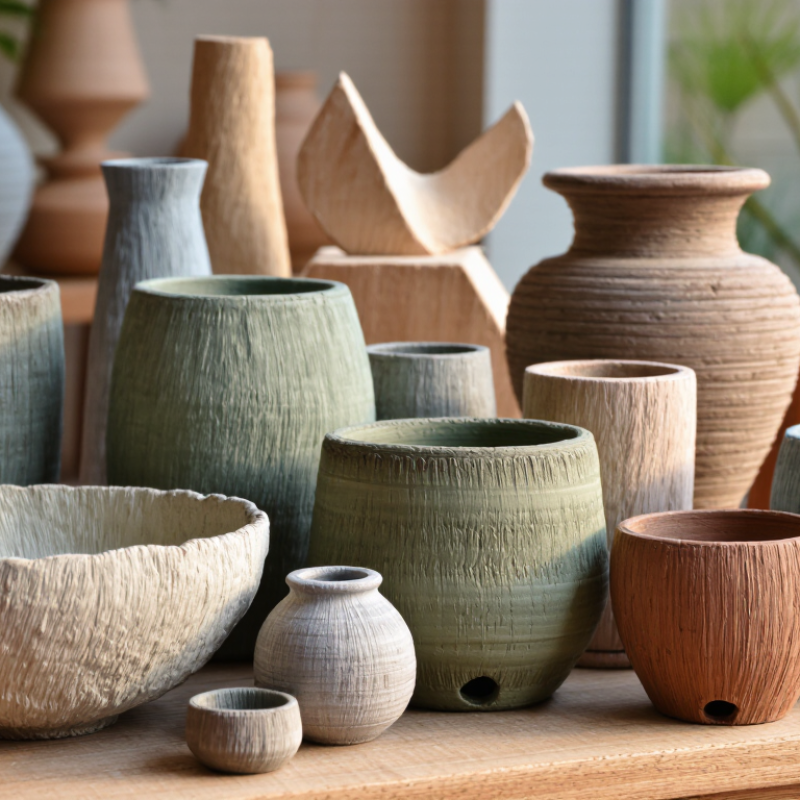
Fiber clay pottery is made by blending clay with short fibers, commonly cellulose or paper pulp, before shaping. The fibers help wet clay hold together during forming and can reduce tearing in thin or detailed areas. They also make some pieces easier to repair while the clay is still damp. Not magic.
During firing, organic fibers burn away, leaving tiny spaces in the ceramic body. This may reduce weight, but it can also affect porosity and strength. The final result depends on the clay, fiber amount, drying speed, firing temperature, and glaze. A “fiber clay” label alone does not guarantee a specific performance.
For global buyers comparing pottery types, look closely at wall thickness, surface finish, weight, and intended use. A small planter and a decorative sculpture may use similar mixtures but need different levels of water resistance and structural support. Ask suppliers whether pieces are glazed inside and whether care instructions address prolonged moisture. One point is easy to overlook: fiber recipes and workshop methods vary, so the term is not always used consistently. Requesting a sample can reveal more than a product description.
| Type | Defining Features | Common Uses | Buyer Considerations |
|---|---|---|---|
| 1. Round Planter | A familiar circular form, commonly made with a wide opening and a stable base. Fiber reinforcement can help reduce weight compared with some solid clay forms. | Patios, entryways, balconies, and general container planting. | Check internal dimensions, drainage provision, and whether the finish is suitable for the intended indoor or outdoor use. |
| 2. Tall Cylinder Planter | A vertically proportioned shape with a relatively narrow footprint; often used to create height in a planting arrangement. | Doorways, commercial entrances, and grouped landscape displays. | Confirm stability when planted, the usable soil depth, and the product’s weight both empty and filled. |
| 3. Bowl Planter | A low, broad vessel with a generous opening, making plants and surface arrangements easy to view. | Succulents, seasonal flowers, mixed planting, and tabletop displays. | Its shallow profile may limit root depth; check drainage and the dimensions of the planting area. |
| 4. Trough Planter | An elongated container with a rectangular or gently curved plan, suited to linear planting arrangements. | Railings, window areas, pathways, and boundary planting. | Check support requirements when full, drainage-hole placement, and whether its length fits the installation area. |
| 5. Urn-Style Planter | A decorative profile that may include a rounded body, narrower neck, and raised or pedestal-like base. | Formal gardens, courtyards, and focal-point displays. | Review the opening size, base stability, and whether the design includes drainage or requires a separate inner pot. |
| 6. Tapered Square Planter | A geometric container with straight sides that may narrow toward the base, giving it a clean, architectural appearance. | Modern landscapes, terraces, and symmetrical arrangements. | Check the top and base measurements, corner finish, and flatness of the surface where it will stand. |
| 7. Wall Planter | A compact vessel or pocket designed to sit against or attach to a wall; some designs have a flattened back. | Vertical gardens, courtyards, and small-space planting. | Confirm the mounting method and load capacity of the wall. Account for the combined weight of the planter, soil, and water. |
| 8. Hanging Planter | A suspended vessel supplied with, or designed for, a hanging support; typically suited to compact planting. | Covered patios, balconies, and indoor plant displays. | Verify the suspension hardware, safe load rating, drainage arrangement, and suitability of the ceiling or support point. |
| 9. Bonsai Pot | A low-profile container, often with a broad opening and drainage provisions suited to shallow-rooted bonsai arrangements. | Bonsai display and other compact, shallow-rooted plantings. | Check drainage-hole size and placement, tie-down options, and dimensions appropriate to the plant and growing method. |
| 10. Sculptural Decorative Vessel | An ornamental form that may feature textured surfaces, irregular contours, or a distinctive silhouette; it may be decorative rather than intended for planting. | Interior styling, garden focal points, and dry or artificial arrangements. | Confirm whether the vessel is watertight and intended to hold soil or water; decorative finishes and construction vary by product. |
Buyer note: “Fiber clay” can refer to different clay-based composites and manufacturing methods. Composition, weight, drainage, finish, and weather resistance vary by product. Request the material specification and care guidance for the particular item, and do not assume that every fiber clay product is frost-proof or suitable for prolonged outdoor exposure.
It combines clay with cellulose fibers, often processed paper pulp. The fibers burn away during firing, leaving a lighter body with tiny pores.
Makers may hand-build it, press it, or cast it in a mold. Fiber can help large forms hold their shape before firing.
Check the base, drainage openings, rim, and wall thickness. Look for repeated hairline cracks or weak, uneven edges.
No. Ask whether outdoor performance and frost resistance have been tested. Lightweight construction alone does not prove frost resistance.
Common forms include floor and tabletop planters, cachepots, bowls, trays, vases, and hanging pots. Wall plaques, lanterns, and sculptural objects are also made.
Do not assume so. Ask about the finish and intended use before serving food in a decorative bowl.
A wide planter needs a stable base. Check its dimensions, drainage holes, and whether a saucer is available.
Request close-up photos of the rim, base, and surface. Slight variation can feel handmade, but it may complicate packing and quality checks. That trade-off deserves thought.
The outside may feel dry while moisture remains inside. Drying and firing schedules depend on the clay, fiber content, and kiln, so makers should test samples.
Fiber Clay Pottery combines clay with reinforcing fibers to create pieces that can be lighter and easier to handle than many conventional ceramic forms. Its appearance, weight, and performance depend on the materials used, the shaping and drying methods, and the surface finish. This overview introduces common production considerations and explores ten types, ranging from planters and bowls to decorative vessels and garden features, highlighting how form relates to function.
Different finishes can influence a piece’s texture, visual character, and suitability for indoor or outdoor use, while construction and care affect durability. For global buyers, useful factors to assess include dimensions, weight, finish consistency, intended application, packaging, and handling requirements. Comparing these details helps buyers select Fiber Clay Pottery that fits their design needs and practical expectations.