A Fibre Clay Trough Planter is a long, lightweight container made from a blend of clay, natural fibres, and reinforcing materials. It offers the textured appearance of traditional stone or terracotta. However, it is easier to move across a patio, balcony, or garden border.
Its wide, narrow shape suits repeated planting. Imagine three lavender plants, trailing thyme, or compact grasses lining a sunny entrance. The planter creates rhythm without demanding much space. Drainage remains essential. Excess water can damage roots and weaken the container during freezing weather.
Garden designer and container-gardening specialist Isabelle Palmer says, “A planter should be chosen as carefully as the plant it holds.” This practical view explains why size, drainage, finish, and placement matter together. A beautiful trough can still fail if it holds water or overwhelms delicate plants.
Fibre clay also develops character over time. Its surface may show subtle colour changes, small marks, or weathering. That is not always a defect. Some gardeners prefer this softened appearance. Others expect a perfectly uniform finish and may feel disappointed.
Before buying, check the planter’s internal dimensions, drainage holes, wall thickness, and frost guidance. Lightweight does not mean fragile. Nor does it mean indestructible. A raised position, pot feet, and careful winter protection can extend its service life.
This guide explores what a Fibre Clay Trough Planter is, how it is made, and where it performs best. It also considers its limitations, because honest selection usually creates better planting results.
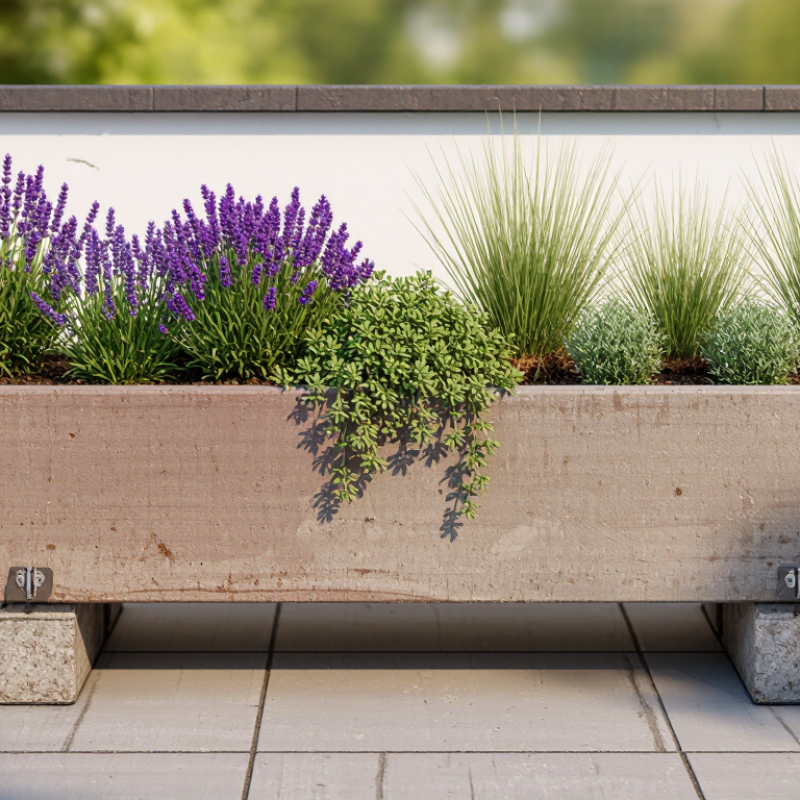
A fibre clay trough planter is a long container made from clay, mineral powder, and reinforcing fibres. It resembles stone or terracotta, but weighs considerably less. The trough shape suits window ledges, balconies, entrances, and narrow garden beds. Its broad profile supports several plants in one visual line.
Core characteristics include a textured surface, moderate structural strength, and resistance to ordinary outdoor weather. However, fibre clay is not indestructible. Repeated freezing, trapped water, and rough handling can cause cracks. A drainage hole is essential. Without it, roots may sit in stagnant water after heavy rain.
The USDA’s 2022 Census of Agriculture recorded over 17 billion dollars in U.S. nursery and greenhouse product sales, showing the scale of professional plant production. Such production depends on reliable containers, although this figure does not measure fibre clay planters specifically. Meanwhile, Grand View Research’s 2024 garden equipment analysis reports continuing growth in home gardening demand. That trend supports interest in decorative, space-efficient containers.
In practical use, a fibre clay trough should have an even base and clean drainage opening. I would also leave a small gap between the planter and a delicate surface. The material often looks heavier than it feels, which can mislead buyers. That visual solidity is useful, but it is not the same as guaranteed frost resistance.
A fibre clay trough planter is not simply a clay container. It usually combines a cementitious or clay-based mixture with reinforcing fibres, lightweight aggregates, water, and mineral pigments. The exact recipe varies by manufacturer, and the term is not perfectly standardized. That matters when comparing weight, strength, and weather resistance.
Manufacturing starts with accurate batching. Dry ingredients are blended before water and fibres are added gradually. Excess water can create pores and weaken the planter. The mixture is then pressed, cast, or vibrated into a long trough mould. Fibre distribution must remain even, especially around corners and drainage openings. After demoulding, controlled curing allows the binder to harden. Some producers apply a breathable sealer, although sealing is not a cure for poor compaction.
Small details reveal manufacturing quality. Look for consistent wall thickness, clean drainage holes, and no exposed fibres. Tap the surface gently. A hollow, cracked sound deserves attention. The International Energy Agency’s 2023 cement analysis links cement production with about 7% of global CO2 emissions, so reducing unnecessary material remains important. Lightweight formulations can lower handling demands, but they may sacrifice impact resistance. This is the difficult trade-off. Fibre clay can look convincingly handmade, yet repeated freeze-thaw cycles may expose weaknesses sooner than expected. The 2024 Global Decorative Concrete Market analysis also identifies texture, durability, and outdoor suitability as major purchasing factors. Reports differ in market boundaries, so their figures should not be treated as absolute.
| Data Dimension | Typical Material or Specification | Function in the Planter | Manufacturing or Performance Notes |
|---|---|---|---|
| Product Definition | Long, rectangular or oval planter made from a fibre-reinforced mineral composite | Provides a lightweight alternative to solid stone, terracotta, or concrete troughs | The exact formulation varies by manufacturer, but fibre clay products generally combine a mineral or clay-based matrix with reinforcing fibres. |
| Mineral Matrix | Clay, cementitious binder, stone powder, sand, or other mineral fillers | Forms the rigid body and provides surface texture and visual weight | The balance of binder and filler affects density, strength, porosity, surface finish, and curing time. |
| Reinforcing Fibre | Usually glass fibre or another compatible synthetic reinforcement | Improves tensile strength and helps limit cracking in thin sections | Fibres are distributed through the composite or placed in selected layers, depending on the production method. |
| Water | Controlled quantity used to create a workable mixture | Activates cementitious components and allows the material to be mixed, cast, or laminated | Excess water can increase porosity and shrinkage, so the water-to-binder ratio must be controlled. |
| Additives | Pigments, plasticisers, water-reducing agents, or surface modifiers | Adjusts colour, workability, water resistance, and appearance | Additives are formulation-dependent and should be selected for compatibility with alkaline cementitious materials. |
| Typical Wall Construction | Thin composite shell, commonly about 5–15 mm in many lightweight designs | Reduces product weight while maintaining adequate rigidity | Actual thickness depends on planter length, geometry, reinforcement layout, and the required load capacity. |
| Mould Preparation | Rigid mould made from plastic, fibreglass, metal, or a similar non-porous material | Controls the planter’s length, width, depth, corners, and surface pattern | The mould is normally cleaned and treated with a release agent before material is applied. |
| Surface Layer | Coloured or textured mineral-rich face coat | Creates the visible colour, texture, and decorative finish | A face coat may be applied before the structural layers to reduce visible fibre patterns and improve consistency. |
| Layer Application | Hand lay-up, spray-up, casting, or a combination of these methods | Builds the shell to the required thickness and embeds reinforcement | Hand lay-up is suitable for shaped or small-batch products; casting is more suitable for repeatable moulded forms. |
| Corner Reinforcement | Additional fibre or thicker composite at corners and high-stress areas | Reduces the risk of cracking during demoulding, transport, and handling | Long trough planters benefit from reinforcement around corners, rims, mounting points, and drainage openings. |
| Curing | Controlled ambient or accelerated curing until the binder develops strength | Stabilises the composite and improves dimensional integrity | Curing time depends on formulation, temperature, humidity, shell thickness, and the selected binder system. |
| Demoulding | Removal after sufficient initial strength has been achieved | Releases the formed planter without damaging edges or surface details | Premature demoulding can cause distortion, chipped edges, or hairline cracking. |
| Finishing | Edge trimming, sanding, surface cleaning, and optional protective coating | Improves safety, appearance, and resistance to staining or moisture penetration | A coating may alter the colour, sheen, breathability, and weathering behaviour of the surface. |
| Drainage Design | One or more drainage holes, sometimes with an internal channel or raised base | Allows excess irrigation water to leave the root zone | Drainage holes should remain unobstructed; a saucer, tray, or suitable outdoor drainage surface may be required indoors. |
| Weight Characteristic | Generally lighter than an equivalent solid concrete or stone trough | Reduces handling and installation effort | Weight still increases with planter length, wall thickness, saturated soil, and retained water. |
| Weather Performance | Suitable for outdoor use when correctly formulated and finished | Supports use in gardens, terraces, balconies, and commercial landscapes | Freeze-thaw exposure can damage porous mineral composites if water is retained inside the body; good drainage and appropriate winter care are important. |
| Dimensional Stability | Rigid after curing, with limited shrinkage and expansion | Maintains the trough shape during normal service | Changes in moisture and temperature can still produce minor movement, especially in long, thin-walled planters. |
| Quality Checks | Visual inspection, dimensional checks, drainage inspection, and surface examination | Confirms consistency and identifies defects before shipment | Common checks include wall uniformity, edge integrity, pinholes, exposed fibres, cracks, colour consistency, and drainage-hole alignment. |
| End-of-Life Consideration | Mineral composite body with a limited proportion of synthetic reinforcement | Influences disposal and potential material recovery | Recycling options depend on local facilities and the specific binder and fibre formulation; reuse as a planter is often the simplest option. |
A fibre clay trough planter combines clay-based material with reinforcing fibres. It looks like stone but weighs much less. The long, narrow shape suits herbs, grasses, flowers, and compact shrubs. In outdoor planting, it can define patios, entrances, balconies, and low garden borders. Its muted surface usually becomes more attractive as dust, rain, and weather soften its appearance.
The main advantage is manageable weight. One person can often reposition an empty trough without lifting heavy concrete. Fibre clay also provides enough depth for many seasonal plants and allows flexible planting arrangements.
Drainage holes are essential, especially where rain collects. Without them, roots may remain waterlogged after storms.
There are limitations. Fibre clay is not indestructible. Repeated freezing and thawing can create small cracks, particularly when the planter stays saturated. I have seen hairline damage grow after one cold season. That warning is easy to overlook. Raise the planter slightly, keep drainage clear, and avoid dragging it across hard surfaces. Strong sunlight may gradually fade the finish, while vigorous roots can become crowded in narrow troughs. Large planters may still need two people to move safely. A sheltered position helps, but it does not remove every risk. Careful watering matters too, because the material can dry faster than thick concrete. Some advice sounds overly confident; local weather should guide the final choice.
A fibre clay trough planter combines clay-based material with reinforcing fibres. It offers a lighter alternative to solid stone or concrete. Its long, low profile suits balconies, patios, entrances, and garden borders. In practice, I have found that troughs create stronger visual rhythm when repeated along a wall. However, an oversized planter can make a narrow space feel crowded.
Choosing the right size starts with the plants and their root depth. Allow extra room for growth, drainage, and seasonal maintenance. A trough around 60 to 90 centimetres long suits herbs or compact flowers. Deeper models work better for shrubs and plants with spreading roots.
Check the planter’s weight after adding soil and water. Your surface may not support it safely. Rectangular shapes feel modern, while softly curved edges appear more relaxed. I once chose a narrow trough for convenience, but watering became awkward.
Tips: Measure the space twice. Keep at least 10 centimetres between the planter and nearby walls. Choose drainage holes that will not block easily. A matte finish hides dust and small scratches. Smooth finishes look cleaner but show water marks. Weathered textures add character, although they may collect soil. Fibre clay can tolerate outdoor use, but severe frost and standing water may cause damage. Check the care guidance before leaving it outside year-round.
Planting, Placement, and Maintenance Guidelines
A fibre clay trough planter combines mineral fibres with a clay-like finish. It looks substantial, yet weighs less than solid stone. In my own container trials, drainage mattered more than appearance. Choose a trough with clear drainage holes, then cover them lightly with mesh. Fill it with a quality potting mix containing compost and aerating material. Avoid ordinary garden soil, which can become dense and waterlogged. Keep the plant’s root crown level with the surface. Do not bury it.
Placement affects both plant health and planter life. Most flowering plants need several hours of sunlight, while leafy plants prefer gentler light. Check the location during the hottest afternoon period. A wall can reflect intense heat. Leave a small gap beneath the trough if its base stays wet. This improves airflow and reduces staining. I once placed a trough directly on paving, and trapped moisture discoloured the underside. I should have used supports earlier.
Tips: Water slowly until excess moisture drains out. Check the top few centimetres before watering again. Rotate the trough occasionally for even growth. Remove faded flowers and damaged leaves promptly. During freezing weather, raise the planter and reduce watering. Fibre clay can tolerate outdoor conditions, but repeated freezing and thawing may cause cracks. Inspect it each season. A hairline crack is easy to overlook. Replace saturated soil when drainage becomes slow, even if the plants still appear healthy.
It is a long container made from clay, mineral powder, and reinforcing fibres. It resembles stone or terracotta, but weighs less. The trough shape suits balconies, window ledges, entrances, and narrow beds.
Usually, yes. It feels lighter than solid stone. However, its heavy appearance can mislead you. Check the carrying distance before buying.
Drainage holes prevent roots from sitting in stagnant water. Cover them lightly with mesh, not solid material. Without drainage, heavy rain can quickly damage roots.
Use potting mix containing compost and aerating material. Avoid ordinary garden soil because it may become dense. Keep the plant’s root crown level with the surface.
Match the location with the plant’s light needs. Flowering plants often need several sunny hours. Leafy plants usually prefer gentler light. Watch for reflected heat near bright walls.
Leave a small gap beneath the planter. Supports improve airflow and keep the base drier. I once placed one directly on paving. The underside became discoloured, and I should have acted earlier.
Water slowly until excess moisture drains out. Check the top few centimetres before watering again. Remove faded flowers and damaged leaves. Rotate the trough occasionally for balanced growth.
It tolerates ordinary outdoor conditions, but it is not indestructible. Repeated freezing and thawing may create cracks. Raise the planter, reduce watering, and inspect it each season. Hairline cracks are easy to miss.
Look for even walls, clean drainage holes, and no exposed fibres. A gentle tap should not produce a cracked or hollow sound. Material quality varies widely. Lightweight construction may reduce strength, which is an inconvenient trade-off.
A Fibre Clay Trough Planter is a long, practical container made from a blend of natural fibres, clay-like materials, and binding agents. It is designed to provide the textured appearance of stone or traditional clay while remaining lighter and easier to handle. During manufacturing, the materials are shaped, dried, and finished to create a durable surface that can suit both modern and classic outdoor settings. Its main benefits include a balanced combination of strength, visual appeal, and manageable weight, although it may still require care in freezing weather or when exposed to harsh impacts.
When selecting a Fibre Clay Trough Planter, consider the available space, the mature size of the plants, drainage requirements, and the desired colour or surface finish. Use quality planting soil, add suitable drainage holes, and position the planter where plants receive the correct amount of sunlight. Regular watering should be adjusted for seasonal conditions, while occasional cleaning and checks for cracks will help maintain its appearance and performance.