The Macro Economics of Fiber Clay & Pineapple Art Manufacturing
An in-depth study on material transformation, structural performance ratios, and global sourcing paradigms for high-durability clay sculptures.
In the contemporary landscape of global architectural embellishment, urban landscape design, and premium residential outdoor living, traditional terra-cotta, cast concrete, and unreinforced ceramics face significant logistical and structural limitations. The international commercial decorative market has rapidly pivoted toward engineered composite formulations—specifically Fiber Clay (Magnesium Oxide / MGO Matrix) integrated with bio-mimetic geometric textures such as the iconic Pineapple Clay Art motif.
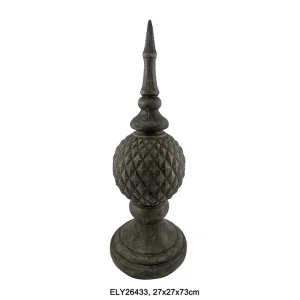
Pineapple clay art—historically prized across European and American architectural history as the universal symbol of hospitality, prosperity, and structural elegance—presents unique manufacturing challenges. The intricate diamond-patterned facets (botanically known as the fruitlets or eyes) demand precise mold release dynamics, high tensile resistance against mechanical stress, and exceptional weatherability. As a premier manufacturer established in 2010 in Xiamen, Fujian Province, Elandgo Crafts (Xiamen Elandgo Crafts Co., Ltd.) under the technical direction of founder Mr. Lai (boasting over 20 years of artisan mastery), has pioneered the industrialization of Fiber Clay Pineapple Art and architectural statuary.
Material Science: Fiber Clay (MGO) vs. Traditional Media
The core innovation behind Elandgo Crafts' Best Pineapple Clay Art lies in our proprietary chemical bonding process. Conventional clay pots and statues suffer from micro-fracturing due to water absorption and subsequent freeze-thaw expansion. Fiber Clay eliminates this structural vulnerability by combining high-purity magnesium oxide (MgO), magnesium chloride ($MgCl_2$), fiberglass mesh scrims, and eco-friendly organic fillers.
| Performance Metric | Elandgo Fiber Clay (MGO) | Traditional Terracotta | Cast Concrete (GRC) | Polyresin / Fiberglass |
|---|---|---|---|---|
| Specific Gravity / Density | 1.2 – 1.4 g/cm³ | 2.1 – 2.3 g/cm³ | 2.4 – 2.6 g/cm³ | 1.1 – 1.3 g/cm³ |
| Flexural Strength (MPa) | 18 – 25 MPa | 5 – 8 MPa | 12 – 16 MPa | 15 – 20 MPa |
| Water Absorption Rate | < 6.5% | 12.0% – 18.0% | 8.0% – 10.0% | < 1.0% |
| Freeze-Thaw Resistance | Pass (-30°C / 50 Cycles) | Fails (Cracks easily) | Moderate Risk | Pass (UV Degrades) |
| UV & Fire Rating | Class A1 Non-Combustible | Class A1 | Class A1 | Combustible / Fades |
| Carbon Footprint Index | Low (Ambient Cure) | High (Kiln Fired 1100°C) | High (Cement Kiln) | Very High (Petrochemical) |