Engineered specifically for the extreme temperature variations of the Balkan climate, offering high tensile strength, UV stabilization, and lightweight installation flexibility.
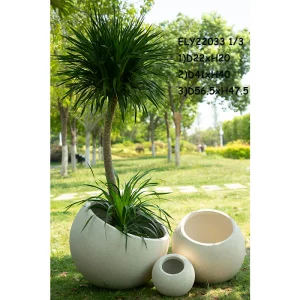
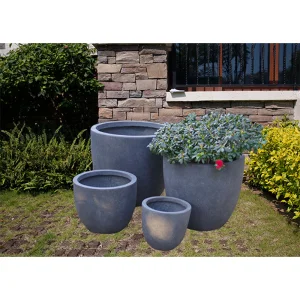
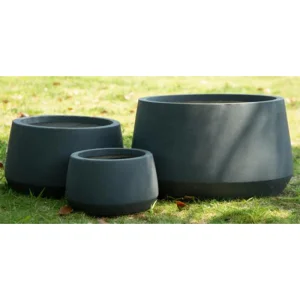
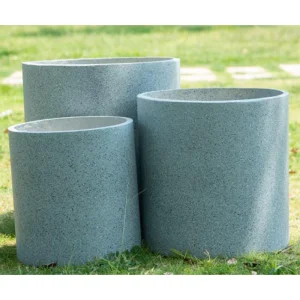
Bulgaria’s rapidly expanding urban infrastructure, fueled by significant commercial investments in Sofia, Plovdiv, Varna, and Burgas, has generated unprecedented demand for modern architectural planters and industrial pottery solutions. Historically famous for its artisanal terracotta heritage—most notably the traditional Troyan pottery (Троянска керамика)—the Bulgarian market is currently undergoing a structural transition. While handcrafted terracotta maintains cultural reverence, contemporary commercial developments, municipal green spaces, luxury coastal resorts along the Black Sea, and high-density residential complexes require scalable, freeze-thaw resistant, and lightweight structural containers that traditional kilns cannot efficiently supply at scale.
As a key economic gateway to the Southeastern European (SEE) region, Bulgaria presents unique climatic and logistic requirements for imported pottery products. Commercial buyers, landscape developers, and retail chains across municipalities like Vitosha, Lozenets, and the Black Sea resort corridors require products that can withstand severe continental winters—where temperatures frequently drop below -15°C in mountain sectors like Bansko and Borovets—while resisting high UV exposure and dry heat during summer months.
To assist Bulgarian procurement directors, landscape architect agencies, and commercial distributors in evaluating structural containers, our engineering team has compiled a rigorous technical matrix comparing modern Fiber Clay composite pottery against traditional terracotta, Glass Fiber Reinforced Concrete (GRC), and rotational molded plastics.
| Performance Parameter | Fiber Clay (MgO Composite) | Traditional Terracotta | GRC (Concrete) | Rotational Plastic |
|---|---|---|---|---|
| Structural Weight | Ultra-Lightweight (Easy balcony load compliance) | Heavy (Logistics strain) | Very Heavy (Requires crane/hoist) | Extremely Light (Prone to wind tipping) |
| Freeze-Thaw Resistance | Superior (Tested to -20°C with 0% surface spalling) | Poor (Prone to cracking under frost) | Moderate to High | High (But degrades under UV) |
| Water Absorption Rate | < 6.8% (Hydrophobic slurry sealed) | 12.0% - 18.0% | 5.0% - 8.0% | 0.1% (Non-breathable, root rot risk) |
| Flexural & Tensile Strength | High (Multi-layered alkali-resistant fiber mesh) | Low (Brittle failure) | Very High | Medium (Warping over time) |
| Aesthetic Realism & Texture | Natural mineral stone/ceramic patina finish | Classic clay aesthetic | Industrial concrete finish | Artificial plastic look |
| Eco-Footprint (Carbon Cost) | Low-Energy Curing (Room-temp chemical binding) | High (Kiln firing @ 1100°C) | High (Portland cement intensive) | Petrochemical dependent |
As demonstrated above, Fiber Clay composite pottery strikes the optimal technical balance for Bulgarian commercial deployments. Its breathability protects plant root health during high-heat periods in Southern Bulgaria (e.g., Plovdiv and Sandanski), while its high tensile strength resists physical shocks during freight transit and urban placement.
Formulated with premium inorganic mineral binders and high-grade alkali-resistant glass fibers to endure the rigorous seasonal swings of continental Central and Eastern Europe.
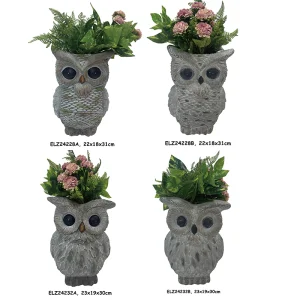
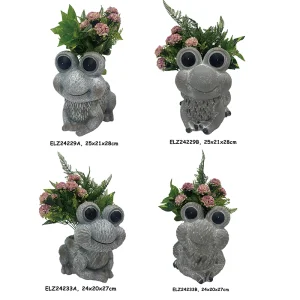
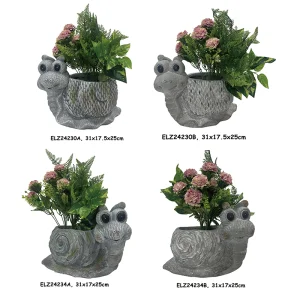
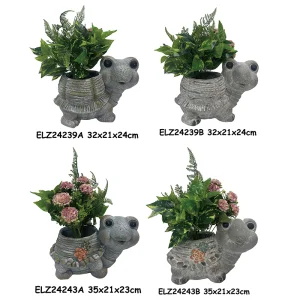
From minimalism geometric troughs for Sofia business parks to organic animal planter sculptures for boutique garden centers, our OEM facility satisfies precise custom design requirements.
Direct containerized shipping routes to Port of Varna and Port of Burgas, supported by complete EU customs documentation, TARIC classification, and EUR.1 certifications.
To maximize commercial value for Bulgarian B2B clients, our product designs address the aesthetic and functional criteria of specific regional developments across Bulgaria:
Modern commercial real estate in Sofia prioritizes rooftop gardens, corporate terraces, and interior biophilic lobbies. Structural weight restrictions on elevated slabs necessitate lightweight containers. Our tall square planters, trough flowerpots, and cylinder pots provide large soil volume for ornamental trees and hedges without exceeding floor load capacities established by Bulgarian construction codes (BDS EN standards).
Coastal resorts require outdoor planter displays that endure high saline aerosol, humid marine air, and intense summer sun. Traditional glazed pottery often suffers glaze crazing or thermal shock cracking when exposed to salt spray and temperature drops. Our UV-stabilized, non-corrosive Fiber Clay and decorative animal planter series maintain surface integrity against maritime weather, reducing replacement costs for hotel management operators.
Plovdiv, as Europe's oldest continuously inhabited city, blends classical architecture with modern urban spaces. Our classic bowl, sphere ball, and egg-shaped fiber clay collections emulate natural stone and traditional stoneware aesthetics, seamlessly matching historical cobblestone plazas, pedestrian thoroughfares (such as Knyaz Alexander I Street), and municipal public parks.
Browse our extensive selection of fiber clay planters and sculpted accent pottery engineered for commercial importers, garden retail centers, and bulk landscape contracts.
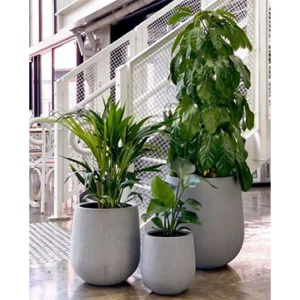
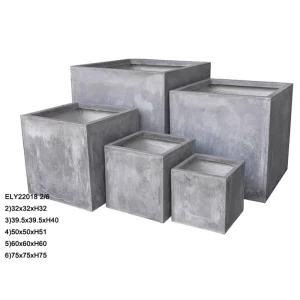
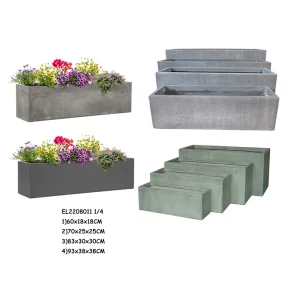
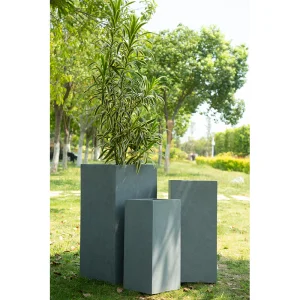
Sourcing large-scale ceramics and fiber clay pottery from overseas requires total transparency regarding raw material sourcing, chemical stability, and environmental compliance under European Union directives. Elandgo Crafts enforces a comprehensive quality assurance framework designed specifically to simplify EU imports for Bulgarian partners.
Our raw material process utilizes high-purity Magnesium Oxide ($\text{MgO}$) combined with aqueous Magnesium Chloride solutions ($\text{MgCl}_2$) to form a dense Sorel cement matrix. This chemical reaction develops high early strength without requiring energy-intensive high-temperature kilns, reducing embodied carbon emissions by up to 60% compared to traditional ceramic firing processes.
To eliminate structural micro-cracking caused by seismic shifts or mechanical impact during transport, our molds integrate woven alkali-resistant (AR) glass fiber mesh with a minimum $\text{ZrO}_2$ (Zirconia) content of 16%. This guarantees long-term alkaline resistance inside the cement matrix, preventing fiber degradation over decades of moisture exposure.
All surface pigments and protective sealants applied to our flowerpots are strictly zero-VOC and heavy-metal free. Our products comply fully with Regulation (EC) No 1907/2006 (REACH), ensuring that no harmful leachable substances (such as lead or cadmium) contaminate urban soil or groundwater in Bulgarian installations.
Prior to container loading at our export facility, random samples from every batch undergo rigorous stress testing: freeze-thaw chamber cycling (-25°C to +40°C over 48 hours), water absorption immersion tests, and diagonal drop testing to ensure structural integrity during ocean transit across the Bosporus Strait into Black Sea ports.
We understand that supply chain reliability is paramount for Bulgarian importers, commercial wholesalers, and landscape contractors. Our dedicated B2B trade desk provides end-to-end logistics coordination tailored to Bulgarian port infrastructure and customs framework:
Addressing core technical, legal, and operational questions for commercial importers, landscape architects, and retail buyers.
Traditional terracotta absorbs 12-18% of its weight in water. When moisture freezes inside the clay pores during cold Bulgarian winters (down to -20°C in mountainous regions), the expansion causes spalling, micro-fracturing, and total structural collapse. Fiber Clay features an inorganic mineral matrix with under 6.8% moisture absorption and embedded glass fiber mesh, giving it elastic resistance to freeze-thaw expansion cycles without cracking.
Bulgarian architectural codes establish maximum static load limits ($kg/m^2$) for residential and commercial elevated balconies (e.g. standard BDS EN regulations). Fiber Clay containers are approximately 70% lighter than solid concrete (GRC) and 50% lighter than traditional ceramic pots of identical dimensions. This allows architects to specify large-format planter troughs and tall square pots without exceeding engineering structural dead-load limits.
Standard ocean transit time from Xiamen Port to Port of Varna or Burgas via Suez/Mediterranean maritime lanes is approximately 25 to 32 days. Production lead times for standard FCL orders range between 30 to 40 days. We advise our Bulgarian partners to schedule seasonal stock orders 60-75 days ahead of peak spring landscaping demand (March/April).
Yes. We specialize in OEM and ODM solutions. We can match custom RAL color codes, implement custom surface textures (such as brushed concrete, distressed stone, slate, or terra-cotta patina), and embed custom barcode labels, hangtags, or debossed brand logos for Bulgarian retail garden chains and wholesale distributors.
Absolutely. All our pottery and flowerpot materials undergo strict testing to ensure zero heavy metal leaching (Lead, Cadmium, Arsenic free) and zero VOC off-gassing. They fully meet EU REACH standards (EC 1907/2006) and are safe for both indoor residential use and outdoor organic agricultural planting.
Our standard MOQ per production run is typically 50–100 pieces per SKU depending on size. However, for full container load orders (20GP or 40HQ), we allow clients to mix multiple shapes, sizes, and animal statue deco-pots to maximize container fill volume and minimize unit shipping freight costs.
Transform your commercial landscape developments, hotel resorts, or retail catalog with high-performance, frost-resistant fiber clay pottery. Request a complete digital catalog, sample package, or direct wholesale price quote today.